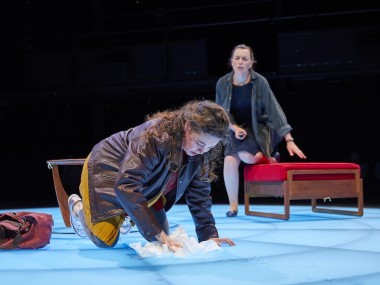
Albatross, Omnibus Theatre
Thursday 28th May 2026
Over the past few years, I’ve lost count of the number of plays that lack drama: their stories are conflict-free zones. But occasionally I come across a play that bucks this trend, and that’s exactly what Martha Loader’s new work, Albatross, does. And then some. It is full of emotional drama, sharp conflict and fighting spirit. Now at Omnibus Theatre in London, it has been produced by Menagerie theatre company and is finishing an East of England tour which began at the Mercury Theatre in Colchester in April.
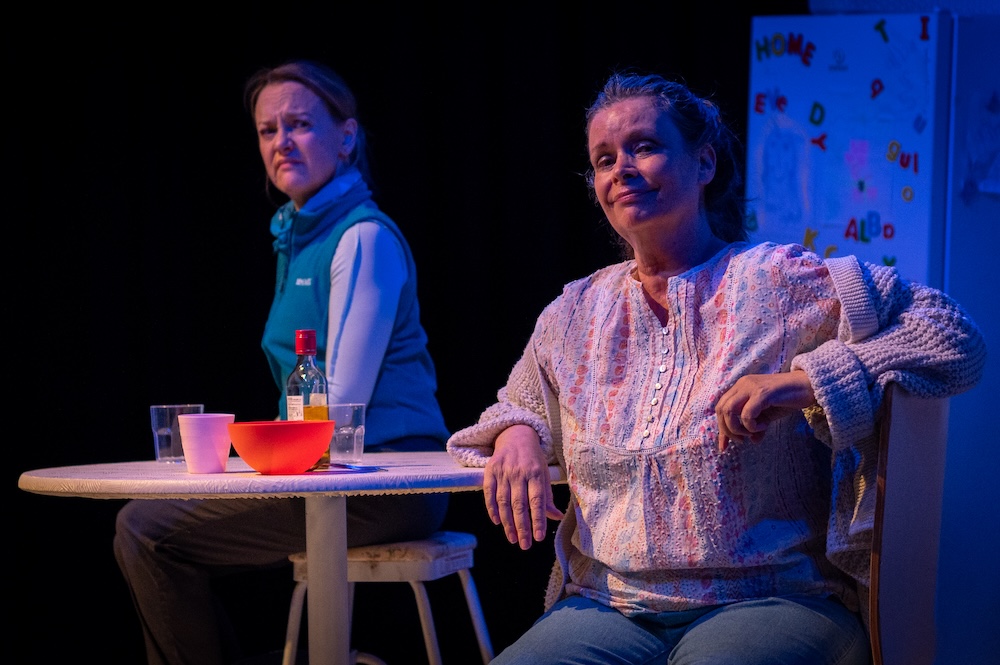
Set in a small town north of Cambridge, it’s a female family reunion play. Sixty-four-year-old Eve is a widow whose husband died about a year ago, and whose 39-year-old daughter Alice comes home unexpectedly from a scientific trip to Antarctica, where she is heading research on the effects of climate change on glaciers. While she has been away, her mother has been looking after Alba, Alice’s five-year-old daughter. At the same time, she has started a new relationship with Martin, who’s slightly younger than her. As they plan to go on a cruise to South American and beyond, the question arises: who will look after Alba?
The conflict between mother and daughter is strongly and effectively portrayed. Alice passionately wants to pursue her career, which she convincingly describes as crucial to the survival of humanity: it’s vital to know what is happening to the Antarctic ice. But at the same time she assumes that her mother has no real independent life — catching Eve having sex with Martin is a shock. Loader perceptively shows how children, when they leave home, assume that the family scene will remain unchanged. But it doesn’t. So Alice is angry to discover not only Eve’s relationship with Martin, but also their desire to leave her alone with Alba, which means putting her own highly successful career on hold.
Things are made more intense when Alice talks to Martin, who has also experienced separation from his own children (albeit in a different key). They are opposites: while she is a rigorous scientist, he is a new age spiritualist. She studies ice melt and glaciers, he believes that fossil bones discovered in the Antarctic have healing powers. She talks about funding for science; he chats about vibrations, forces and energies. But they both also discover a momentary energy that connects them. Trouble is, and another source of conflict, Eve believes in this new age stuff, while Alice despairs because her mother, like society, ignores the evidence of climate change. Despite the fact that Eve’s house has been flooded recently.
But Loader also focuses on Alice’s inner conflict. Sure, she’s a committed scientist who travels across the world to do her work, and is respected by her peers, and is passionate about her mission (which Eve suggests she inherits from her now-dead father), but she’s also a mother. She feels heartbreak, she knows in the deepest way possible what it’s like to be separated from Alba. And this internal contradiction between work and motherhood is sharply represented. And it’s a conflict felt by so many women. Added to this, Alice has to face the resentment felt by Eve, a single grandmother who has to bring up her daughter’s child, and who has also had to clean up after the flood. Eve articulates a powerful criticism of what she sees as Alice’s fanaticism and hypocrisy.
Along with a very well written account of these conflicts, which give heart to this excellent drama, the playwright adds the albatross of the title, which is echoed by the name of Alice’s daughter. This stuffed bird, which sits at the side of the stage in Menagerie’s co-artistic director Patrick Morris’s meticulous production, designed by Chris Dobrowolski, is a gift and a symbol of both good luck and of heavy burden (“an albatross around your neck”). In the play text, there’s an apposite quotation from Samuel Taylor Coleridge’s 1798 poem, The Rime of the Ancient Mariner, the most well-known literary example of this maritime myth. But this image also brings to mind Anton Chekhov’s The Seagull, another multifaceted avian symbol.
The main problem with Albatross is that its 80-minute running time doesn’t really allow enough room to thoroughly explore some of the play’s other themes, such as intergenerational conflict, middle-age aspirations (including online dating) and climate scepticism. As it is, the least satisfactory aspect of the play is the ending, which feels rushed and a bit perfunctory, with some parts of the storytelling not really thought through: was the cruise just a fantasy or have the characters actually booked it? Such issues could have been tackled without depriving the play of its momentum or its impact. On the other hand, Morris brings out the piece’s theatricality with a fizzing albatross, rice pudding cookery and a memorable scene in which Alice demonstrates ice-shelf melt by using a large tub of ice cream.
In fact, Albatross is very well served by its cast: Agnes Lillis convincingly portrays Eve as an ordinary not very well-educated woman who is no fool, and has devoted her life to caring for others, but now wants her own adventure. She is a warm personality, attracted to the optimism of new age ideas, while Caroline Rippin’s Alice is highly strung (“like a tennis racket”), very cold in every sense, torn between the desire to be a hero for the greater good and her maternal feelings. Director Morris plays Martin with a lovely mix of nerdy spiritualism and anxiety to please. Loader, who won the George Devine Award last year, has written an engrossing and commendably well-researched drama, and is clearly a name to watch.
© Aleks Sierz
- Albatross is at Omnibus Theatre until 30 May.