Des Hommes Endormis, Athénée Théâtre Louis-Jouvet
Monday 18th May 2026
Is British theatre allergic to Continental modernism? You know, the type of writing that rejects the conventional devices of naturalism and social realism, that pins down emotional truth by means of a more leftfield sensibility. The reason I ask is that Martin Crimp, who along with Caryl Churchill is surely the best living British playwright, has written two superb full-length dramas that have never been staged in the UK. Published as The Hamburg Plays, they are The Rest Will Be Familiar to You from Cinema and Men Asleep, first staged at the Deutsches Schauspielhaus Hamburg in 2013 and 2018. The second play, translated into French with the title Des Hommes Endormis, is currently playing at the Athénée theatre in Paris in a brilliant staging by Ludovic Lagarde.
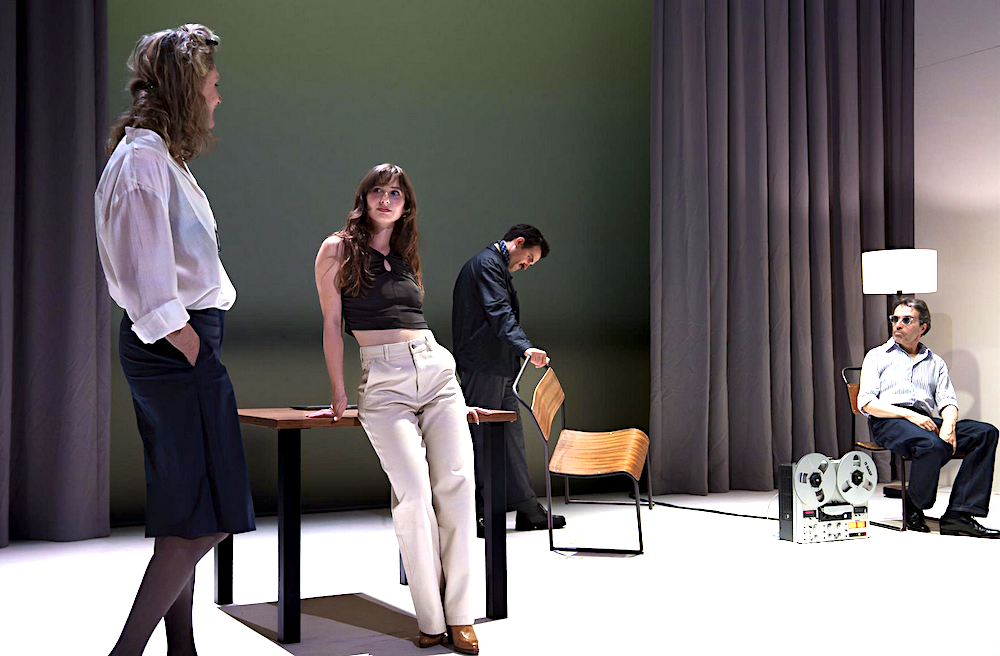
The setting is an elegant Hamburg apartment, where a middle-class 50something couple, Paul, a musician, and Julia, an art historian, reside. It is late one night, around 2am, and Julia has invited two young people, Josefine, her new assistant from work, and Tilman, her husband, a highly successful furniture entrepreneur, to come over. Although Paul is aghast because Julia has not mentioned this invitation, and there is neither food nor drink in the flat, he soon recovers and joins in an elaborate power play in which the older and younger couples establish, in a kind of Pinteresque way, their relationships to one another. Emotions are heightened because, while Julia and Paul are childless, Josefine thinks she’s pregnant — but hasn’t told neither her husband nor her boss.
If this set up feels vaguely familiar, that is because it is. Directly inspired by Edward Albee’s 1962 masterpiece Who’s Afraid of Virginia Woolf?, a new production of which is coming to @sohoplace in September, Crimp has reimagined the original in a freshly contemporary way. Instead of George, a failing Eng Lit academic, he has Julia, a successful art academic; instead of the drink-loving Martha, he has the rather austere Paul. Likewise, his younger couple replace the aspiring Nick and the childless Honey with the capitalist Tilman and apparently pregnant Josefine. These twists give the power plays between the couples a satisfying sense of surprise. Other echoes of the original also appear: the humiliation of a sharp punch, sensual dancing and the risks of too much booze.
Instead of literary references, there are mentions of art history, which is relevant to Julia’s job. In particular, the work of Rudolf Schwarzkogler and Otto Muehl, two members of the Viennese Actionism group, are mentioned when she discusses her prickly rapport with a fictional Californian-based artist called Marko, whose work she despises. He is hassling her to produce text for an exhibition programme, and insists that she changes her wording to suit him. Clearly, this is another aspect of power games — the tension between creatives and academics. And the repeated refrain from Julia’s article about Marko — “persistent traces of overwhelming violence — ghostly aftershocks of representation itself — the artist’s unique voice is not in question” — could be Crimp’s self-description of his own writing style.
The strong themes of the play include its atmosphere of the emptiness of modern living, the fatigue of having devoted yourself, as Julia and Paul have, to career success, and a kind of openness to the bizarre in everyday discourse. As successful academics whose work enables them to interact with the art world and music business, Julia and Paul have sacrificed much of their intimacy, and now have little physical interest in each other. Instead, there’s a not of the perverse in the suggestion that violence in a relationship might be evidence of love. Still, they comes across as a stable, confident power couple, able to ignore the occasional wobbles in their marriage.
If Julia and Paul’s relationship is one in which the fires of desire are pretty much extinguished, the opposite is true of the younger couple. Tilman and Josefine love sex, drugs and rock ’n’ roll. They kiss and embrace, laugh and enjoy the hedonism of contemporary youth. Yet, even here there are darker notes: their childhood memories are not happy, and Tilman is anxious about his “shit”-filled mind. In fact, he’s also worried about having a child: will it inherit his worst traits? By contrast, Josefine — who resembles Ulrike Meinhof — is energetically in the moment, laughing at the fact that the couple have so much sex, while also needing the photos their friends have taken of them to completely remember the couplings. All very digital age.
Men Asleep takes its title from a painting by Maria Lassnig, an Austrian artist who died in 2014, and whose image of naked men sleeping is strikingly tender. So Crimp’s Paul and Tilman develop an odd, slightly homoerotic, connection, a bit rivalrous, a bit spiky, perhaps bit violent. But the crucial factor in this imagined relationship is ambiguity: if, as the title indicates, the men end up asleep, we never know if they are sleeping together, in any sense, or whether — compared to the women — they lack emotional intelligence. Are they metaphorically asleep? Half awake. Dozy.
But at first the playwright focuses on the women: Julia’s relationship with Josefine, her new employee, starts off with a pleasant excursion as they leave the flat to find some alcohol, and bond over drinks at a late-night bar, before returning full of laughter. Girls just wanna have fun. They bond. But they are not equals: Julia dominates they way they tell the story of their absence, and, by the end of the play, the social hierarchy is re-asserted: Julia makes clear who’s the boss. So while the younger woman says that she is pregnant, it is unclear as to whether this antagonises her employer, who might be childless for a variety of reasons, also deliberately unstated.
The key tone of the play is a mildly satirical one, with touches of the absurd, evoking these complex power games. Crimp writes with a deeply humanistic sensibility in a way that defies the clichés of British naturalism. Instead of realistic conversations, with subtext and instantly recognisable psychology, his characters explicitly express their thoughts and feelings: what is usually left unsaid is here openly stated. The effect is a rich text which fills 90 minutes of stage time with thought-provoking moments (Julia is known to dislike women, but promotes their interests anyway) and heart-grabbing episodes (the threat of physical violence feels very real).
Lagarde’s compelling production, using a fine translation by Alice Zeniter, is designed by him and Sébastien Michaud, creating a coolly contemporary apartment with a frosted glass wall which allows us to see the outside balcony as a blurred almost dreamy space whenever the characters pop out for fresh air. The cast is excellent: with contrasting couples, the older in some senses resigned (Christèle Tual and Laurent Poitrenaux) and the younger more passionately engaged (Hortense Girard and Guillaume Costanza). With a soundtrack that includes Beethoven as well as dance music, this is a play whose abrupt shifts in tone and meaning are a constant pleasure, and which conveys a sense that reality is more fluid than ever.
The effect is of a night piece in which dreams and nightmares cohabit with desires both familiar and half-understood. Yes, this is our world, occasionally funny, often discombobulating and sometimes downright sad. As these four characters struggle psychologically to dominate the claustrophobic territory of this apartment, you get a distinct felling that this is Continental modernism at its best, most precise, most revealing. But, since the play has not been staged in Britain as yet, this also means that Crimp is something of an internal exile in his own country. But maybe the upocoming National Theatre production of his completely new version of Moliere’s The Misanthrope, starring Sandra Oh, will change that. A bit. It opens next month. Meanwhile, there’s time to catch Des Hommes Endormis.
© Aleks Sierz
- Des Hommes Endormis is at Athénée Théâtre Louis-Jouvet until 24 May.