Soldiers of Tomorrow, Finborough Theatre
Thursday 18th June 2026
The Finborough Theatre is one of the smallest in London, yet it has a great track record in selecting new plays. With room for barely 50 spectators, its budget is tiny, but its vibe is tremendous. Long-term artistic director Neil McPherson excels at finding, usually by means of his widespread international contacts, rare and often daring contemporary plays, as well as a great line in forgotten classics. His latest is Jerusalem-born playwright Itai Erdal’s 70-minute one-man show, Soldiers of Tomorrow, which has previously been seen in Vancouver and Edinburgh in 2023. It’s an uninhibited account of the conflict between Israel and the Palestinians, both historical and contemporary.
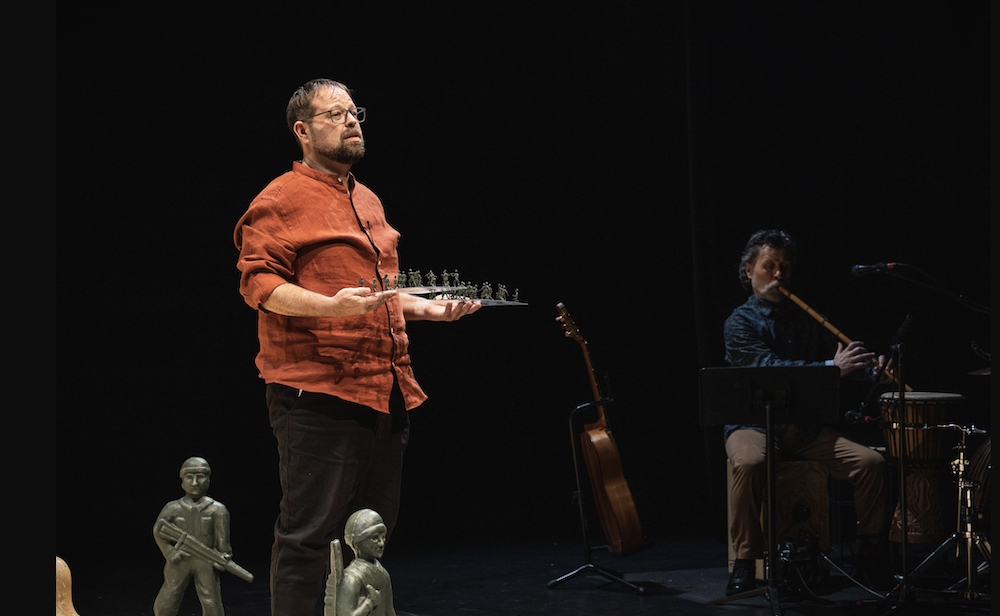
The show starts with Erdal’s personal story about living in Canada, where he emigrated from Israel some quarter of a century ago. He is Jewish and has a regular barber who is an Iraqi Arab: when the straight razor comes out and the barber starts to work on his throat, Erdal experiences the involuntary fear that he is about to be murdered. After all, he feels a lot of guilt about his military service in Israel, and can imagine the deep hatred of all Arabs for the Jewish state. Yet his barber is a very gentle soul, and of course would never harm him. They are friends. Sort of. This beginning, as well as his introduction of the Syrian-Canadian musician Emad Armoush, who is onstage to play oud, Spanish guitar, flute and drum, emphasizes the multicultural aspect of the show.
Erdal’s title comes from a memory of how, one day in Israel, his eight-year-old nephew came home from school with an empty box to be filled with goods for serving IDF soldiers. Inside the box the boy’s teacher had put a note: “To the soldiers of today from the soldiers of tomorrow.” The rest of the play describes his own experiences of military duty, with some reflections on the conflict between Israel and the Palestinians in the past and in the present. He determines to dissuade his nephew from joining the army, especially as this conflict becomes increasingly intense. (He openly accuses the Israeli army of genocide in Gaza.)
The complex history of the land that Israel now claims for itself, whether in Gaza or the West Bank or Jerusalem, where he enjoyed living as a young man, is performed using the different flags and symbols of the various nations which contested the territory over the past 4,000 years. These include Israelites and Babylonians, Romans and Egyptians, Jews and Muslims, Christian invaders and Ottomans, and, yes, of course, the British. Oh, and the ever-present Palestinians. At the same time, Erdal meditates on the paradoxes of national feeling, questioning how far you can be part of a country when you passionately disapprove of the state’s actions. Yet, he also acknowledges that you can’t simply shake of the love of place, the memories and the sensations you remember.
While Erdal understands his father’s view of Israel as a safe place of refuge after the Holocaust and the second world war, he also is quick to point out how Zionists can use this history to defend their own extreme actions. Bravely enough, he allows his characters — friends and fellow soldiers — to equate Israeli attacks on civilians with Nazi atrocities. Which he follows up by reminding us not only that the reputation of the country has been destroyed for years to come, but also that its actions have led to a surge of anti-Semitism worldwide. He also stresses the paranoia of any Jew who lives in a society where Arabs have become more and more suspect, and any Palestinian might be a terrorist. In one extended sequence, he talks about an incident at a border checkpoint where the IDF soldiers have to decide whether to let an old Palestinian woman, who is holding a sick baby, pass. This is compelling in its humanity, and also as an example of the intractability of the conflict.
Without any easy answers, Erdal constantly evokes the paradoxes of living in Israel, especially after the assassination of Yitzhak Rabin in 1995, which destroyed the peace process, and led to the rise of Benjamin Netanyahu. In some passages, this is more of lecture than a well-plotted drama, although the overall structure of the play is neatly circular. Erdal not only says some things that are rarely heard in British media, which is paralyzed by not wishing to offend, but also explores, in the checkpoint story, a real ethical dilemma. Soldiers of today and tomorrow have to obey orders (an excuse he dwells on by mentioning the Nazis), but also can resist an illegal order. But how, in the heat of the moment, can you decide what is legal, or not?
Written with Canadian playwright Colleen Murphy, Erdal’s text is subtle and thought-provoking. Even more than similar pieces, such as Yousef Sweid and Isabella Sedlak’s charming Between the River and the Sea, recently seen at the Royal Court, Soldiers of Tomorrow is tough in its realism, in its truth, as well as being deeply personal. Erdal talks about his guilt at participating in the military oppression of the Palestinians, but also recognizes that Israeli citizens, including his own family, need protection. Need to feel safe. More randomly, he also talks about ancient archeological artefacts or about picking figs on the way to school. Then he can’t resist telling us a couple of Holocaust jokes he remembers hearing in Israel. Yes, the real world is complex.
This excellent show is directed by Anita Rochon, with designer Brian Ball and artist Juliette Demoulin’s colourful set, which suggests the great sweep of Judea, or is it Palestine? One nice touch is the inclusion of model soldiers of various sizes, some of which double as the military men involved in various stories. At the centre is Erdal’s well-focused performance, helped by Armoush’s atmospheric musical accompaniment, being both serious and humorous, with several excellent jokes giving the evening a good pace, calm and considered, a nice contrast to some of the taboo-busting exchanges. When you remember that the issue of Israel and Palestine is so furiously contentious that few theatres will touch it, this is an extremely welcome addition to the London new writing scene.
This review first appeared on The Theatre Times
- Soldiers of Tomorrow is at the Finborough Theatre until 4 July.