Archduke, Royal Court
Monday 29th June 2026
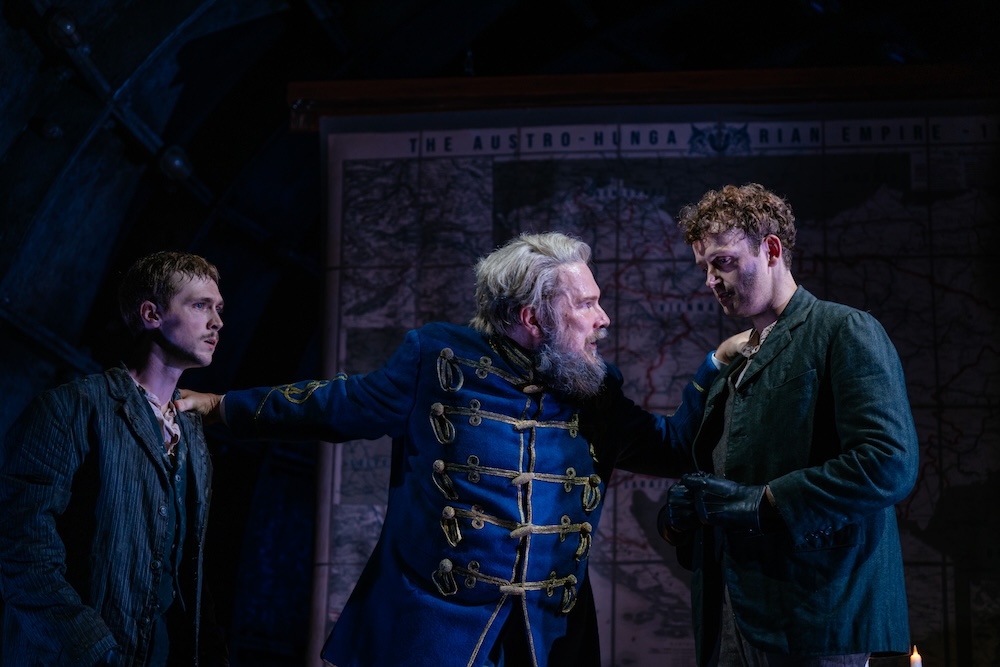
Terrorists are monsters. Or so we are told — pure evil. Well, it makes a good story. Even if it isn’t completely true. Actually, most political assassins are quite ordinary young men, often troubled, often vulnerable, unsure of themselves and so prone to being led by others. American playwright Rajiv Joseph takes this insight and applies it to the Serb terrorists whose actions precipitated the first world war. First staged in New York in November last year, this wild dark comedy is now on the Royal Court’s main stage in a fizzing, occasionally eye-popping, production by director Lyndsey Turner and designer Es Devlin.
Dateline: Belgrade, 1914. The play begins with three 19-year-old men acting on instructions to attend a rendezvous with a mysterious Captain, who — spoiler alert for anyone who doesn’t know their 20th-century European history — will send them to Sarajevo to assassinate the Archduke Franz Ferdinand, heir to the throne of Austria-Hungary, and his wife Sophie. In Zemun, the older Captain, nicknamed Apis, gives them an ideological steer (Austria-Hungary is bad, “a two-headed abomination”; Serbia equals “Slavic unification”, which is good), as well as some arms. Meanwhile, his old servant Sladjana prepares the food and adds her own brand of cranky wisdom. The facts tell us what happens next as the boys set off for Sarajevo.
The brilliant thing about Joseph’s farcical black comedy is that he takes historical characters and morphs them into vivid recreations: so the youngsters Gavrilo Princip (who fired the shots that killed the Austro-Hungarian couple), Nedeljko Čabrinović and Trifko Grabež are reimagined as gawky, often gormless — lost souls searching for meaning, even if they don’t know it. They are easily brainwashed by Dragutin “Apis” Dimitrijević, chief of the military intelligence section of the Serbian general staff, who is transmogrified into a comic pantomime villain, at one point exuding smoke like Satan. The clandestine Serbian group known as the Black Hand is alluded to in an episode where the youngsters get to put on, yes, black gloves.
Historically, the aim of Apis is to free Bosnia and Herzegovina of Austro-Hungarian rule and create a South Slav (Yugoslav) state. In reality, the assassination occurs despite a series of blunders and precipitates the July Crisis, which leads to Austria-Hungary declaring war on Serbia and the start of world war. The bizarre facts of the killing, where the assassins keep making mistakes, are here turned into a comedy of quirky characters, yet the profound point is that history is often the result of accidents, of improbable coincidences and unforeseen effects of casual action. Joseph’s intuition is that these young men could easily have preferred to eat a meal, and chase a girl, rather than going ahead with the assassination plot.
The characters are wonderfully memorable: Gavrilo, Nedeljko and Trifko are drifters who have been diagnosed as consumptive “lungers”. They are virgins and hungry not only for sex, but also for food. Their stomachs rumble. They dream of well-filled sandwiches. And Christianity as well as ethnicity has created their mindsets: Gavrilo says he’s been named after the Archangel Gabriel. Although Gavrilo and Nedeljko are similar, they do have differences: the latter is more uncertain, more afraid of dying, less clever. And Trifko is a great bear of a man, confident in his physicality and his respect for authority.
Each of the boys has been infected with tuberculosis, and Joseph makes an implicit connection between bodily ills and the contagion of fanatical nationalism. Knowing, as we do, about what happened to the former Yugoslavia in the 1990s, when the deep nationalistic feelings of Bosnians and Serbians exploded into civil war, gives an edge to his account of the way that oppressed minorities can process their genuine aspirations into political violence. Vicious ethnic antagonisms take a long time to gestate, and, like tuberculosis, sometimes require years to kill the body politic.
At the same time, the text is infused with ideas about women as witches, with a couple of passages where Gavrilo tells of how he gave a female skeleton, “Lady Bones”, the name Dubravka, only to find her haunting his thoughts. During a couple of moments, Sladjana — who appears to be a great bounty giver, providing food and sustenance to the menfolk — also suggests a more sinister reality. In fact, several parts of the play have a folk-tale sensibility: dark forests haunted by witchcraft fantasies, with lost infants searching for absent parents. And Joseph’s grasp of perverted psychology comes across clearly in his account of Apis’s macabre murder of Queen Draga and King Alexander of Serbia.
The playwright, whose previous hits include Guards at the Taj and Bengal Tiger at the Baghdad Zoo, specialises in a kind of savage clowning which takes blood-soaked reality and shows it to be, in the theatre at least, more a case of spilled tomato ketchup. His text throbs with delightful verbal eccentricities: sex is described as “like taking a bath with a bunch of rabbits — feels soft and warm but also, ‘What am I doing here?’”; the episode in which Sladjana tells the story of her “Momma”’s cat death, and her hilarious if gross vengeance, is like something out of Martin McDonagh’s equally antic The Lieutenant of Inishmore. Then Apis’s boast about disemboweling a pair of royals is simultaneously wildly funny — and grimly revolting in its glee.
Turner directs with a palpable delight in the play’s absurdism and zany sensibility. Devlin’s set starts off as a huge, and hugely oppressive, iron-bolted tunnel which transforms into claustrophobic chambers and a chapel with icons. The final scene is a wonderfully unexpected visual coup de théâtre, as the boys travel by train to their appointment with destiny in Sarajevo. Together, the cast is amazingly comic: Stanley Morgan’s scatty Gavrilo, Abraham Popoola’s imposingly strong Trifko and Chris Walley, who previously made his West End debut in The Lieutenant of Inishmore, lends Nedeljko both vulnerability and some crazed aggressivity. British Comedy Award winner Marc Wootton plays Apis as a mix of manosphere guru and ultra-right politician, while Janice Connolly’s Sladjana is pleasingly down to earth.
There’s something gloriously horrible, yet wonderfully imaginative, in this silly-serious extravaganza, a retelling of history that resonates powerfully today, when so many terrorists are revealed as confused rather than monstrous, yet still extremely dangerous. This vision of nationalism as a farcical, yet potentially destructive, ideology also has a global reach. But it says something about the state of British new writing for the theatre today that so far two of the best plays put on in this venue’s celebratory 70th anniversary are American.
This review first appeared on The Arts Desk
- Archduke is at the Royal Court until 25 July.