
About Notes from a Working-Class Playwright
Wednesday 3rd December 2025
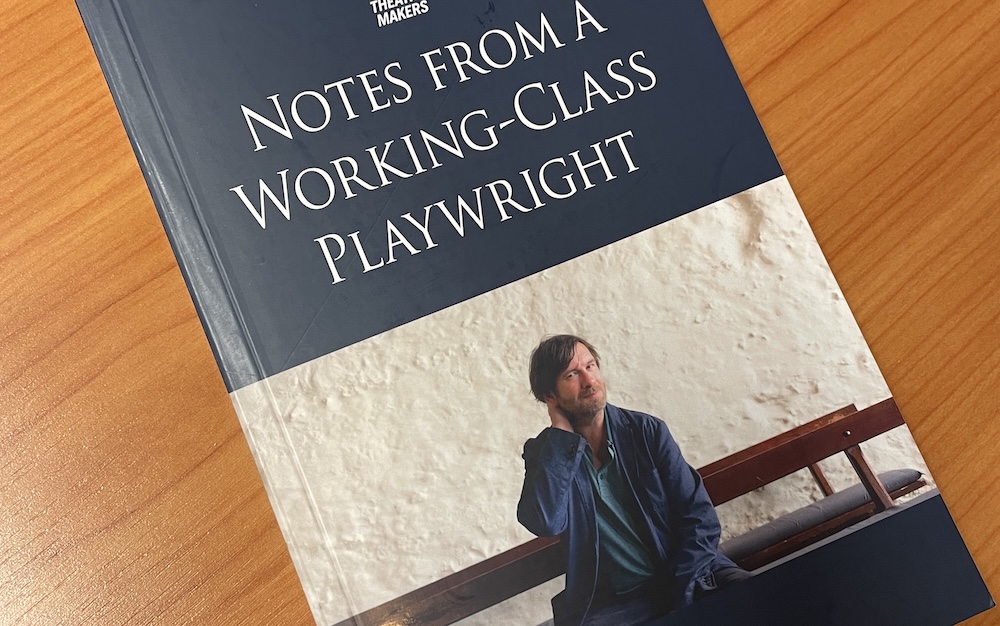
Yesterday I went to the launch of Leo Butler’s passionate book, Notes from a Working-Class Playwright. It was at the Royal Court and the playwright gave a reading from the first chapter, which shows how a wild incident in his student days became, about 12 years later, the emotional and psychic fuel of his brilliant 2008 play for the RSC, I’ll Be the Devil. I’ve written about this satanically dark drama in my book on Rewriting the Nation, calling it “an orgy of tangled and twisted language rich in resonance”, which is nothing compared to the review that Butler quotes, which compared the experience of watching it to “being held hostage by a violent lunatic”. A moment in the reading which raised a wry laugh. Anyway, it was a genuinely beautiful experience to hear Butler read from his book, which looks back over quarter of a century of writing for the stage, and includes his teaching of emerging playwrights at the Royal Court from 2005 to 2014. It starts with some vivid and sometimes distressing stories about growing up in Sheffield, with its school bullies, and then his later move to Rose Bruford College drama school and his adventures in some mind-bending drug taking before getting started in the profession. As well as life on the dole. Then as Butler develops his writing career (or should that be compulsion?), he tells some great stories about his output, which includes Made of Stone, Redundant (and its amazing press night at the time of 9/11), and Lucky Dog, as well as I’ll Be the Devil: sadly, I haven’t seen All You Need Is LSD, but it reads like a gas. Yet this book is much more than an autobiography. Using his experience of mentoring playwrights all over the UK and beyond, Butler offers lots and lots of excellent advice about writing: getting stated, how to develop an idea, how to structure a play, how to find the hidden play inside you, and then some super stuff about coping with rehearsals, press nights and all the rest. I really love his provocative Q&A Exercise, and many teachers will find his twelve-week course of real use. But I also like chapters with titles such as “What the f*ck Is a Dramaturg?” and “Ch-ch-ch-ch-changes!” — cue music. Yes, the book is full of references to pop culture, and is illustrated with photographs and excerpts from his notebooks and so on, and his enthusiasm for the work of other playwrights runs like a thumping heartbeat throughout the text. He also pays tribute not only to directors, but also to lesser known inspirations such as Ola Animashawun of the Court’s Young Writers Programme, and the late Elyse Dodgson of their International Programme. And so much of this is deeply personal, such as extracts of rejection letters and honest recollections of downs as well as ups. Flicking through the book you get a real sense of the author’s personality: leftfield, often inspiring, sometimes cranky, theatrically ambitious and extremely practical. It’s occasionally surreal, sometimes funny and always revealing. Filling you with the feeling of creativity unleashed. Okay, some bits are messy, crazy as fuck, but then so is a playwright’s life. Notes from a Working-Class Playwright is a really fine book about playwriting that’s both fascinating as a life story and compelling as a series of good ideas, all of which glitter in the mind long after you’ve put down the volume.
© Aleks Sierz
- Leo Butler’s Notes from a Working-Class Playwright is published by Methuen Drama.



1 Comment
on Saturday 6th December 2025 at 6:41 am