Arcadia, Old Vic
Monday 2nd March 2026
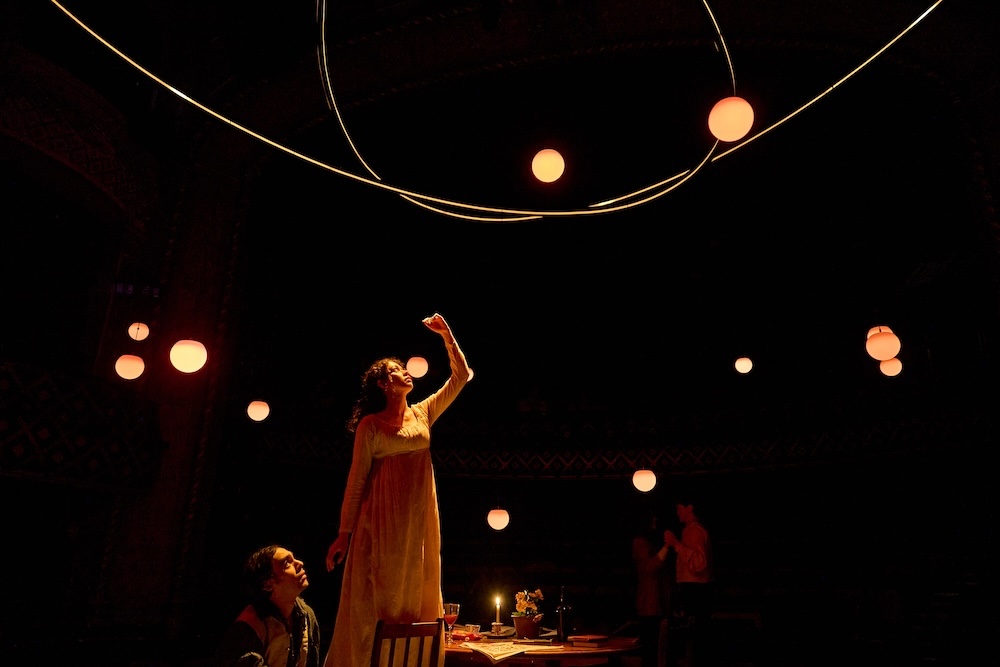
Arcadia is one of my all-time favourite plays. Clearly a masterpiece, it is both intellectually and emotionally stimulating, exploring the two cultures of science and English Lit, with a bit of philosophy and gardening thrown in. Written by Tom Stoppard, who died in November last year, it was first staged at the National Theatre in 1993, with a memorable star cast, which included Felicity Kendal, Emma Fielding, Bill Nighy, Rufus Sewell, Harriet Walter and Samuel West. The play has been revived several times since, and now Carrie Cracknell stages it afresh at the Old Vic in London, in an enjoyable production with an excellent diverse cast.
This witty, cerebral play is set in a Derbyshire country house, Sidley Park, home of the Coverly family, headed by Lord and Lady Croom. Events happen in the same room, overlooking the garden and grounds, in two historical periods: Regency era, 1809–12, and the 1990s present day. In the past it looks at 13-year-old prodigy Thomasina Coverly and her tutor, Septimus Hodge, as they explore science and language, while he also has a brief affair with Mrs Chater, a house guest, leading to a challenge from her husband, the poet Ezra Chater. Things are complicated by the fact that Lady Croom suddenly expresses an interest in her daughter’s education as well as objecting to the activities of Noakes, a landscape architect intent on changing the grounds. Oh, and Septimus’s friend Lord Byron is also a guest.
In the modern period, rival Eng Lit scholars Hannah Jarvis and Bernard Nightingale investigate the history of the house. Hannah researches the obscure Sidley Hermit, while media-don Bernard tries to prove that Lord Byron killed Ezra Chater in a duel. Hannah sees the landscaping of the grounds, a shift from the tidy order of the formal Italian garden to Capability Brown-style natural contours, then to faux rugged wildness inspired by Gothic literature, as a decline: “the nervous breakdown of the Romantic imagination.” In other words, an Arcadia once created by Brown imitating the painter Claude who imitated Virgil now becomes a “Gothic novel expressed in landscape”, complete with a hermit. The Enlightenment turns into Romanticism, “the decline from thinking to feeling”.
While Hannah and Bernard speculate on what happened in the past, Stoppard shows how Thomasina, a natural maths genius, discovers iterated algorithms and also makes jokes about Fermat’s last theorem. The significance of her calculations is explained to Hannah by Valentine, son of the present-day Coverlies and a post-grad biologist and mathematician. He explains contemporary chaos theory, the basis of the notion of the butterfly effect, where a butterfly flapping its wings in Brazil can lead to atmospheric changes that result in a tornado in Texas. The effects of small changes leading to big events pervades the play: an overheard conversation, a casual remark, a borrowed book, a scribble in the margin or a doodle on a map. All these show that human relationships are unpredictable.
As well as using iterated algorithms, Thomasina also speculates about entropy, how the jam in her rice pudding can be stirred in but not stirred out, and Valentine confirms that the second law of thermodynamics means that heat flows constantly from hot to cold, as cups of tea, or indeed the universe, are all always cooling down. But other things heat up: if chaos theory replaces the Newtonian universe, the key hot disruption comes from sex, which is “the attraction Newton left out”. This insight is reached by 18-year-old brat Chloe in the present, the counterpart to Regency-era Thomasina. As Valentine struggles to find mathematical patterns in his subject — the estate’s grouse population over the decades — he acknowledges the “noise” made by real-life complexity. Yes despite this complexity, there is also elegance.
The structure of Arcadia is very elegant with its three past scenes, three present scenes, and a mixed seventh scene in which past and present happen simultaneously. As these scenes mirror each other in dazzling displays of ideas, and wit, so do some of the characters. The Regency Augustus is mirrored by the present-day Gus, Valentine’s brother, who provides Hannah with a solution to her research in literally the final page of the play. By then the characters have discussed free will and determinism, and Stoppard shows the important of choice, doing the right thing. Especially in respect of young women. Septimus behaves well, Bernard doesn’t. And Hannah’s instinct proves right, Bernard’s doesn’t.
Hannah also points out the necessity of using your brain to gain knowledge, to discover the truth: “It’s wanting to know that makes us matter.” For this is a play not only about feeling, but also about thinking. Stoppard brilliantly shows how our understanding of the past depends crucially on documents, which of them survive and which don’t. And on how we read them. At one point Septimus burns an unread letter, knowing full well that he is destroying evidence. The play illustrates how a casual random act, like a doodle, can be misinterpreted. And this is crucially a drama about books: Thomasina is upset when she talks about all the books lost when the library at Alexandria burnt down. And there’s a good Latin joke about Shakespeare too.
At the best of times, all this is not easy to follow on stage, although productions are clearer than the play text, which is pretty dense. Stoppard’s gift for comedy, for bright and incisive dialogue, especially in the verbal skirmishes between Hannah and Bernard, Septimus and Chater, are a delight, and likewise minor characters such as Lady Croom have a wonderful line in putdowns. Yet even the most dazzling passages are put in service of the emotional content of the stories, Septimus’s care for his pupil and her attraction to him, the rivalry between Hannah and Bernard, the despair of Valentine or the arch intelligence of Lady Croom. All this is beautifully brought out in Cracknell’s luminous production.
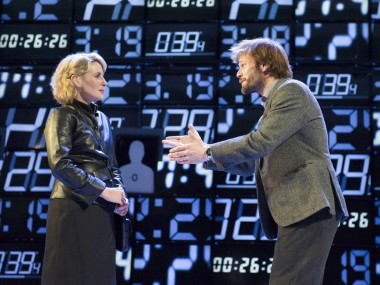
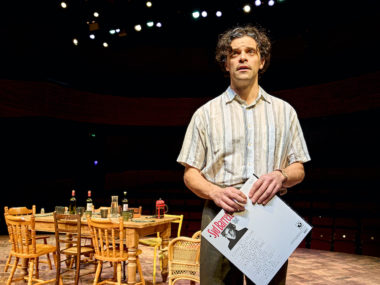
With the Old Vic reconfigured as a theatre-in-the-round, designer Alex Eales’s beautifully geometrical set has dual revolves spinning in opposite directions, itself an indicator of the play’s content. And the cast is excellent: Isis Hainsworth, radiant as Thomasina, and Seamus Dillane, bright as Septimus, contrast well with Leila Farzad, serious-minded as Hannah, and Prasanna Puwanarajah, energetic as Bernard. They are well supported by Fiona Button’s rapier-like Lady Croom and Angus Cooper’s eloquent Valentine. Although I remember thinking this play was bloodless when I first saw it, more than 30 years ago, I have grow to appreciate it so much more since then. Today I think this must be the best three hours of stage time I have recently enjoyed.
© Aleks Sierz
- Arcadia is at the Old Vic until 21 March.