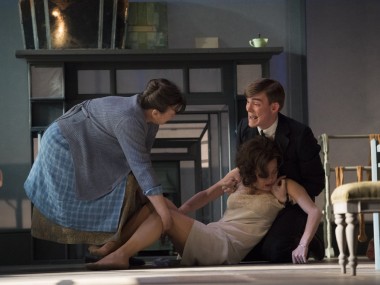
Man and Boy, National Theatre
Tuesday 17th February 2026

Terence Rattigan is a posh playwright whose work encapsulates the emotional restraint of the 1950s, and who was then overtaken by the Angry Young Men. Right? Wrong! Although this sketch of his career is partly correct, and is widely believed, the truth, as ever, is more complicated. Despite the impact of Royal Court new writers such as John Osborne in the late 1950s, Rattigan continued to write. His later plays include Ross (1960), In Praise of Love (1973) and Cause Célèbre (1977). And Man and Boy, first staged in the West End in 1963. Often forgotten, it’s an odd piece that gets a spirited revival at the National Theatre, the first show in the Dorfman space programmed by Indhu Rubasingham as director of the National Theatre.
Set in 1934, five years after the Wall Street crash, the play takes place in the Greenwich Village apartment of Basil Anthony, an impoverished bar-room pianist, song writer and lefty. As he chats with Carol, his actor girlfriend, the couple are visited by his father Gregor Antonescu, who Basil rejected years ago to the point of changing his own name. Dad is a buccaneering Romanian capitalist currently in the news because he faces ruin after a failed attempt at a merger with American Electric, whose boss Mark Herries now also pays him a visit — well away from the media spotlight. Accompanied by their subordinates, Sven Johnson and David Beeston, whose accountancy skills have exposed Gregor as a swindler, the first half culminates in a cut-throat business conflict.
As the energetically megalomaniacal Gregor manipulates the secretly gay Herries by pimping his own estranged son Basil, who’s unaware of what’s going on, and simultaneously runs circles around the straitlaced Beeston, there’s a thrilling charge of contemporary relevance: sex, power and money. Corruption. Cover up. Now, what does that remind us of? Unfortunately, Rattigan’s plotting in the second half of the show relies a lot on introducing a previously unmentioned fraud and a surprise FBI investigation which really does strain credibility. And by introducing another visitor, Gregor’s wife, a typist who has now been bought the title of Countess, the playwright pushes us further in the direction of disbelief.
Still, at the emotional centre of the play is the relationship between father and son. Here Gregor is portrayed as a father who is unwilling to return, or enjoy, or acknowledge, his son’s love. If accepting love suggests that a bad man has the capacity to change, indeed to be redeemed, then Gregor really doesn’t want it. Although Rattigan makes these feelings a bit murky, perhaps because of his own fraught relationship with his diplomat father, the play is more successful at picturing the father than the son, who seems a weak and underwritten character. Instead, Gregor dominates the action, cheating and bullying his way through business ventures, oblivious of the consequences in a kind of binge of self-destructive behaviour. At the same time, he is constantly rewriting his own personal history, covering every move — including his childhood — with invented fantasies. He doesn’t want family: he craves power.
This vision of a rapacious capitalist, partly inspired by the disgraced Swedish match tycoon Ivar Kreuger, has a gloriously larger-than-life quality. The idea is that the really unlawful businessmen, who have compiled dossiers on the foibles and misdemeanors of their competitors, are attractive in the way that Iago, Richard III or Mephistopheles are: compelling our attention even as we disapprove of their behaviour. Safe in our own nice worlds we can gawp at the misdeeds of these cruel and calculating monsters. Especially when they, as happens here of course, finally get their comeuppance. Yes, we have our fun — and justice is done.
In his National Theatre debut, director Anthony Lau gives this Broadway story a metatheatrical flavour. Georgia Lowe’s design includes film-style credits on one wall in art deco-style, names which light up every time a character is on stage, a device which is also emphasized by the bombastic 1930s Hollywood music which introduces the show. This kind of thing is given a cheeky twist with the words “Knock knock” emblazoned above the entrance to the apartment. The rest of the set is a green baize-like floor, a bare stage with a piano, clothes rack, radio and three tables under Elliot Griggs’s massive lighting rig which tilts expressionistically over the action.
Lau’s direction is equally in favour of exaggeration: his characters are constantly moving the tables around, often clambering onto them, jumping up, jumping down, their extremely busy moves suggesting the energy of 1930s New York. But the star of the show is not the set, but Ben Daniels, whose Gregor — like Anthony Trollope’s corrupt financier Augustus Melmotte in The Way We Live Now (1875) — is a magnetic figure who looms, often literally when he jumps onto the tables, over all the other characters. The sheer energy of his performance, shifting between accents, sometimes Romanian, sometimes French, is compelling in a jaw-drop way. Here’s grandeur, here’s charisma; here’s also bathos. It’s mesmerising.
The vampiric figure of the international moneybags dominates the story, but the hugeness and luridness of the performance also negates any empathy. And the rest of the actors are caught in this cartoon-like gig, with Phoebe Campbell’s Carol, and Leo Wan’s Beeston and Isabella Laughland’s Countess Antonescu particularly exaggerated. As Basil, Laurie Kynaston produces a detailed reading of the lost son, yet he is overshadowed on stage, as in the story, by the theatrics of the father. And this time Rattigan’s writing has little of his famous subtext for the actors to examine. Nick Fletcher’s Sven and Malcolm Sinclair’s Herries take things seriously, and neatly push the plot along. But despite the resonance with today’s coteries of power, from Trump to Putin, and from Bernie Madoff to Jeffrey Epstein, this is less an emotional analysis of corruption, and more of giddy, often farcical, romp through a 1930s morality tale.
This review first appeared on The Theatre Times
- Man and Boy is at the National Theatre until 14 March.