Lost Atoms, Lyric Hammersmith
Tuesday 3rd February 2026
Some shows have great moments, but somehow just don’t work — the whole is a lot less than the sum of its parts. This is my feeling about Frantic Assembly’s 30th anniversary show, Lost Atoms, which is written by Anna Jordan, and whose tour began at the Leicester Curve in September last year and which now arrives at the Lyric Hammersmith in London. Although this two-hander about a love affair boasts a good cast — Coronation Street’s Joe Layton and Frantic regular Hannah Sinclair Robinson — the piece never really rises about the banal predictability of its script.
This love story has a kind of televisual blandness: Robbie and Jess bump into each other, slowly fall for each other, enjoy a wild weekend, start meeting each other’s families, try to start their own family, then suffer betrayal and finally split up. It’s a very typical story, a kind of every-man and -woman relationship. The trouble is that the writing feels easy, unexpressive and uninteresting. Jordan has made a good career by writing for television, on shows ranging from Killing Eve to Succession and One Day, but what works in that medium doesn’t, in my view, transfer smoothly to the stage. Theatre demands something deeper, more articulate, more expansive linguistically.
The other problem is that this superficial play actually contains five other plays: the rom-com with its meet cute and social and sexual awkwardness; the cringingly funny meet-my-ghastly family play; the tragic pregnancy play (done so much better by Luke Norris in Guess How Much I Love You?); the grim betrayal and its discovery play; and the our-fantasy-future play. Each of these, or a combination of two of them, would make a really great 90-minute show. Instead we have a play that lasts more than two-and-half hours — and feels like it’s three. By the end, the lack of dramatic focus, of compelling conflict, makes you heartily wish for a rapid end.
Despite the piece’s overall blandness, there are some moments of eccentric pleasure: I like the Crazy Gold scene, the knickers in the handbag episode, the rather uneasy and eventually tender love making. Some memorable lines also stand out: Robbie’s typical night in (“pot noodle and a wank”) and Jess’s suggestion about him having therapy (“Have you ever seen a counsellor about your mum?”). There are moments of sharp perception, and Jordan creates characters that are realistic in that they are not particularly likeable. Nor well suited. Robbie is too self-involved and repressed, too bitter and unambitious; Jess is too fun-loving, outgoingly gregarious and passionate about the arts. But what unites them is a common sense of failure.
This rather somber and depressing tone is emphasized by the awful experience that Jess has when she becomes pregnant. In the most emotionally true, and fraught, passages Jordan explores her grief, and the play’s titular loss, with enormous sympathy, showing very realistically the devastating feelings she experiences. As ever, this is a gendered situation, and Robbie can’t really grasp, or indeed completely empathize with, the horrible things that happen to Jess’s body. But powerful as these scenes are, there’s a distinct feeling that the woman is being defined by her body, her biology. I wanted to know more about her artistic side. About her as a person.
Lost Atoms is also irritatingly full of gaps: an interesting idea, or theme even, is introduced — and then dropped. One example is Jess’s interest in tradition folk tales and their violence. Oh, that sounds interesting. And then there’s another reference to it. But then nothing more. Another potentially interesting point is how couples remember critical incidents of their relationship differently. Once again, you think that this is interesting. And one or two examples of contested memory are staged. But then this fizzles out. Such gaps mean that you never really get a sense of character development: both Jess and Robbie remain ciphers.
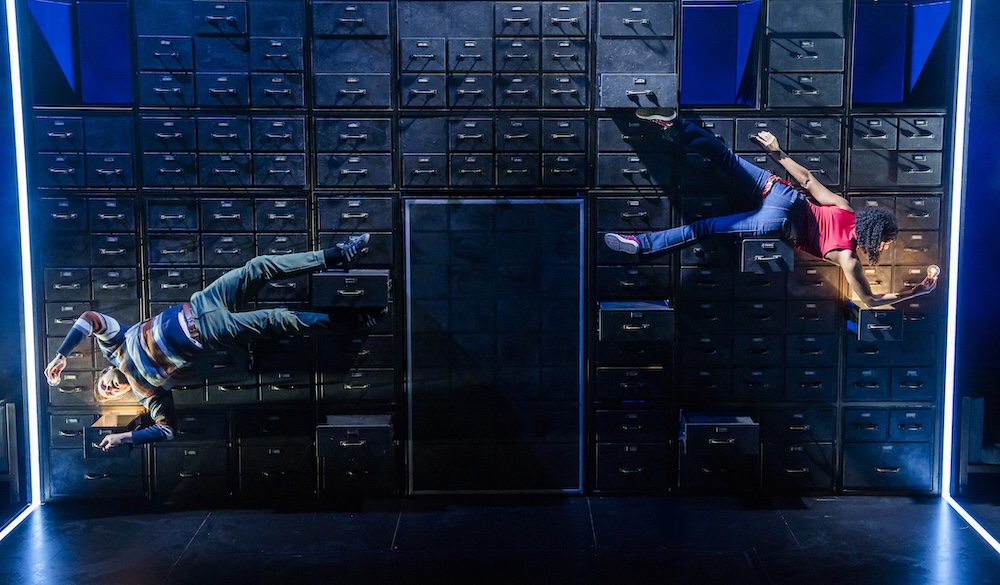
None of this helped by Scott Graham’s production for Frantic Assembly. The set, by Andrzej Goulding, is a huge bank of filing drawers in which memories and props are stored, with a bed or platform in the middle. It looks stupendous, visually arresting. But it also traps Layton and Sinclair Robinson in a grid which they climb up and slide over, hang onto or swing down from, all of which results in some beautiful stage pictures, but also can become as frustratingly repetitive as the text. And although both actors effectively make the dance-like moves that are the signature of this theatre company, their onstage relationship lacks connection: there are no sparks between them, which makes it difficult to believe in their love.
As with Frantic’s Metamorphosis and I Think We Are Alone, two previous shows, the disappointing thing about this one is the poverty of much of the writing, the lack of specificity and surprise, and the chronically pedestrian feel of the plotting and character under-development. While the story of odd opposites attracting (he a badly dressed cook who teaches troubled youths, she an aspiring artist and wild party girl) has a lot of potential, here it gets bogged down by a restrictive set and an over-long production. Surely there is so much more that could be said about love, sex and loss, but isn’t. Sad to say, it’s not so much atoms that are lost as an entire evening.
This review first appeared on The Theatre Times