Nayatt School Redux, Coronet Theatre
Wednesday 22nd April 2026
At a time when, in the post-Brexit years, British theatre is increasingly insular, a visit by the Wooster Group, legendary veterans of American experimental theatre, is surely worth celebrating. So many thanks to Anda Winters, Artistic Director of the Coronet Theatre, for this excellent programming. As this show’s name suggests, Nayatt School Redux is a revisiting and a reworking of Nayatt School, one of the company’s earliest and most celebrated pieces, created by Spalding Gray and Elizabeth LeCompte. It was first staged in New York in 1978, and this recreation, which uses newly restored archival recordings of the original, premiered there in 2019.
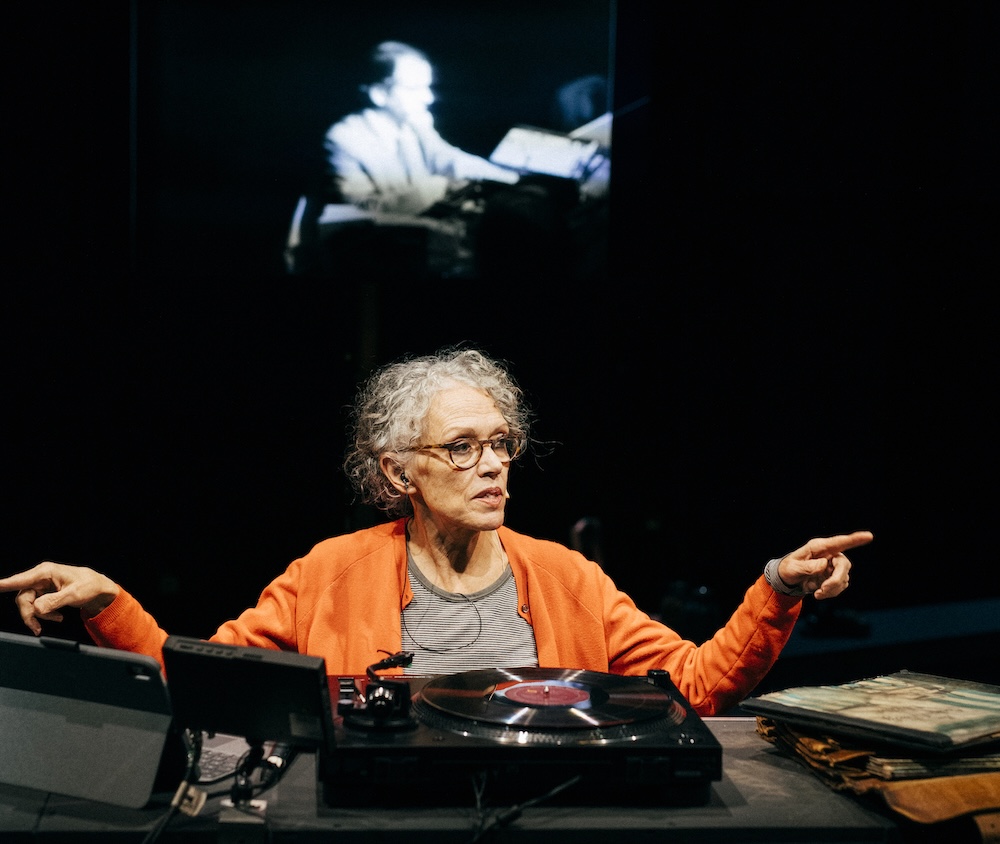
Gray, a co-founder with LeCompte and others of the company in the late 1970s, pioneered the genre of autobiographical monologue and the piece’s title is that of a school he once attended. This version begins with Kate Valk, who joined the group in 1979, facing the audience at a long table and chatting to us about the show. She explains that Gray, when he was a kid, wasn’t very keen on reading, but preferred to listen to vinyl records, such as Drop Dead! An Exercise in Horror, a 1962 compilation of Arch Oboler’s gothic sketches, and TS Eliot’s 1949 verse drama The Cocktail Party, with its original cast, headed by Alec Guinness. So Nayatt School was, and is, partly Gray’s remembrance of his upbringing, and partly an anarchic staging of episodes from Drop Dead! and from The Cocktail Party.
Gray’s mother was a Christian Scientist, who disapproved of the radio and pop culture, so he had to listen to broadcasts and records in secret. She also suffered from depression, and committed suicide in 1967. Clearly, his use of the ending of Eliot’s play, when Celia goes on a religious mission to Africa and is crucified by locals and then eaten by ants, brings together memories of the religious fanaticism of his mother with Eliot’s equally disturbing account of his invented character. This raises the question of whether fiction can throw light on our lived experience, or, as in this case, perhaps more likely obscure it. Gray was fascinated by Eliot’s play, which he listened to while at home as a boy, but did the fate of Celia say anything relevant to him about his mother? The question hangs over the show.
Nayatt School Redux complicates these ideas about fact and fiction in relation to mental distress and suicide because Gray himself ended his life in 2004, so he is absent from the current performance. His monologue, parts of which are voiced by Valk, is about an absence of another absence, with a family’s two suicides somehow present in the background. Because Valk remembers Gray, this is very much a memory play, and one which stirs up other thoughts, about Eliot and his treatment of his wife Vivienne, who suffered from mental health problems, and his creation of the fictional character of Sir Henry Harcourt-Riley, a kind of spiritual psychologist, in The Cocktail Party, a part played by Gray for the Wooster Group. (Apparently, he had also played Alexander in the same play in 1966 in an American production directed by John Wynne-Evans.)
The density of these personal experiences is central to Nayatt School Redux, which is structured as a kind of tribute to the past, yet very much of the present. As Valk talks, in a compellingly dry and often humorous way, about the original staging, she uses a flat screen behind her which shows archival footage of an early performance of Nayatt School. Filmed in monochrome with a fixed camera, the image quality is not good and the sound is dreadful so Valk, supported by two other cast members, gives voice to Gray’s monologue. This generates a sense of theatrical archaeology, a deep dive into a partial reconstruction of a legendary show, a feeling which is enhanced by the fact that Valk also tells us about her experiences with the group when she joined it.
The staging is a simplified version of the original set, with, for example, a pink chair, turntables for vinyl records, and a tent frame (the original fabric covering was destroyed by a flood). Although the solid soundproof room features on the archive film recording and is especially important in the staging of scenes from Drop Dead! (the provocative breast examination) is missing, the theatre’s back wall has been made to suggest the Performing Garage, the Wooster Group’s base in SoHo, Manhattan. Once again, these remnants are a reminder of the role of chance in archival records, especially those of live performance. What can be added, of course, is stage action.
So after Valk’s version of Gray’s monologue, in which he memorably mentions the “demented laughter” on the recording of the Eliot play, the rest of the company appear on stage to act out a surreal and wild version of the ending of Eliot’s play. Long live the demented! Costumes are bizarre, the acting swings from almost inert postures to frantic activity, robot gestures, and there’s a sense of fever dream that could go on until everyone collapses. Although the whole show lasts about 80 minutes, this last section seems to stretch time, creating a nightmare feeling while The Cocktail Party, originally a mix of verse drama and naturalism, is satirically taken apart, with injections of loud funk music and some furious hyper-activity. Here, Celia’s ghastly death seems like a form of cosmic joke — yesterday’s avant-garde are today’s jesters.
Directed and designed by LeCompte, all this is thrilling and thought-provoking. But also a reminder about how times have changed. In the original stagings of Nayatt School, a group of 11-year-old children performed along with the adults — Gray, Libby Howes and Ron Vawter — adding their infectious energy and spontaneity to the show. Sadly, this risky element is, I assume, no longer practical in our age of safe-guarding and anxiety about child actors. Likewise, the finale of the play, in which Vawter attempted to play a record with his penis, while another actor reached under her skirt and Gray showed his “bare ass”, is recounted rather than re-staged. After all, this is just too provocative today.
So the passage of time means that a play which talks a lot, albeit obliquely, about violent death, has itself suffered a kind of death by self-censorship. A play about loss has itself been hobbled by loss. On the other hand, many aspects of the spirit of 1970s experimentalism and theatrical craziness have been successfully revived and recreated here, most enjoyably. Thanks to the cast, especially Scott Shepherd as Gray and Harcourt-Riley, Maura Tierney as Celia, but also Ari Fliakos, who are both precise and well-focused in their energy, this is a joyful production, which is well supported by Ken Kobland’s original video, with added dayglow pink and green bits, and Eric Sluyter and Omar Zubair’s soundscape.
This is a show which you can experience with surprise, occasional disbelief, occasional puzzlement, and frequent pleasure. The whole vibe conveys a sense of theatrical, and cultural, freedom. It’s a blend of memory of the 1970s avant-garde past and a sense that the present could also be inspired by this kind of liberated theatre-making. It’s both a nod to history and a glance into the future. When so much of British theatre is under the thumb of brute naturalism and meek realism, the Wooster Group brings a distinctive blast of fresh air. Nayatt School Redux is both profound and, in the best way, surreally silly. It’s a really great show.
This review first appeared on The Theatre Times