Dance of Death, Orange Tree Theatre
Saturday 21st February 2026
Some marriages are made in heaven, we are told. Equally, others are made in hell. The most classic articulation of this on stage is August Strindberg’s Dance of Death, his 1900 play about a claustrophobic “record of hate”, as Graham Greene puts it in his 19501 novel, The End of the Affair. Now, at the enterprising Orange Tree Theatre, director Richard Eyre’s new adaptation of the piece, which was a clear influence on both John Osborne’s Look Back in Anger and Edward Albee’s Who’s Afraid of Virginia Woolf?, stirs in some questionable humour into a work renowned for its spiritual bleakness.
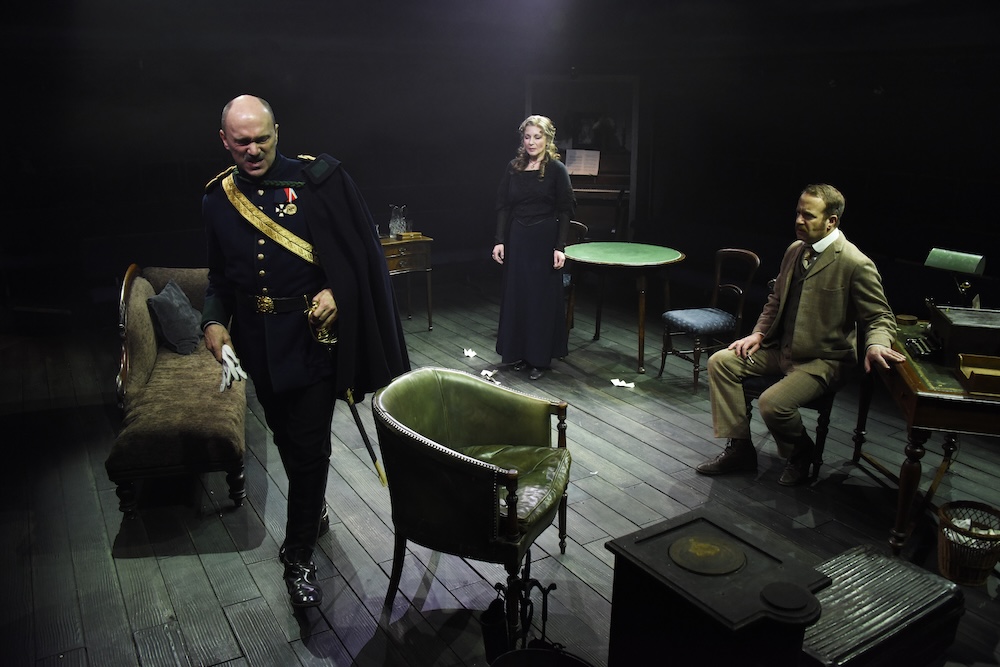
On a windy remote island, the plot takes place just before the silver wedding anniversary of Edgar, an artillery captain, and Alice, a former actress, as they engage in savage emotional combat. When Alice’s cousin, Kurt, a medical man, arrives, he becomes a pawn in their mutually destructive rapport. Edgar is arrogant and suffers from a bad heart, while Alice attempts to seduce and manipulate Kurt into helping her escape — or to destroy her husband. Eyre moves the action to the time of the 1918–19 Spanish flu pandemic, giving the couple a kind of compulsory closeness, with obvious resonance with the COVID-19 experience, which likewise imposed a claustrophobic nearness on many who were unused to this intimacy.
Like some of the paintings of his near-contemporary Edvard Munch, Strindberg’s work has an acutely intense, and often horrible, view of sexual relationships, especially critical of male delusions and female manipulations. His Edgar is a a failure, unable to achieve promotion because he refuses to interact with men he regards as “morons”, yet also a bullying officer who enjoys causing emotional pain to other soldiers. Although afraid of death, he is self-destructive and a liar and braggart. Alice, similarly, is unhappy because she had to give up her acting career when she married, though Edgar reckons she would never have been a star, and because her children have escaped the toxic parental home.
In this tightly-bound marriage, where expressions of hate seem to be as intensely necessary as expressions of affection in other families, Alice is both a victim and a perpetrator, and Edgar both a tyrant and a victim. Kurt, whose wife has left him and taken his children, finds himself torn between his kinship with Alice, which has hints of forbidden incestuous desire, and his attraction to the strong-willed Edgar. But, as the action plays out, he discovers that he has been betrayed, while also becoming an instrument of betrayal himself. In the end, this is a study in complicity in which secrets and lies are revealed, but these revelations change almost nothing. The result is a kind of exhausted stasis.
Typically, the metaphorical language of the play includes the image of the vampirism of this mutually destructive marriage — as British critic Kenneth Tynan once wrote about a similar situation in Look Back in Anger: these are animals “engaged in competitive martyrdom, each with its teeth sunk deep in the other’s neck, and each reluctant to break the clinch for fear of bleeding to death”. So although Alice fervently wants Edgar to die, we know that his absence would also destroy her. Their mutual hate is what keeps them together. Alive. At the same time, they also cannibalise their family and their friends, using them for their own ends. They are nourished by the misfortunes of others.
Eyre’s version of this toxic masculinity, exemplified by Edgar’s competitive edge when playing cards and his propensity to physically attack his wife, has a contemporary feel, and this is emphasised by the use of swearing in the play text, and, in the directing, by some very physical sexual groping. Both Alice and her husband excel at using weakness to gain strength, with his exploiting his poor health to gain advantage, while she uses her disappointment as a weapon. The result is a sado-masochistic situation where the outside world, dominated by a pandemic, really barely intrudes, and nature only becomes present when the doors of the couple’s mutual prison burst open because of the wind.
Eyre’s adaptation provides some comedy, but lacks any sense of Scandinavian bleakness, any sense of strangeness or wildness. On Ashley Martin-Davis’s cluttered set, his direction misses some of the basics of psychological realism: I can’t really believe that Will Keen’s Edgar and Lisa Dillon’s Alice have been married for a quarter of a century — they never really convince as long-term partners. And the performances are so highly charged as to be cartoonish. Keen in particular is energetic without being compelling, mesmerising but also ridiculous in his convulsions and crazily staring eyes. Such big acting feels out of place in this theatre’s small in-the-round space. So while Dillon and Geoffrey Streatfeild, as Kurt, are less over-the-top, they also lack conviction.
This exaggerated reading of the story, when Edgar dances wildly to Johan Halvorsen’s “Entry March of the Boyars”, banged out on an upright by Alice, and where the servants disappear and there’s no food in the house, is a distraction from the theme of marital misery, which would be much more effective as a slow-burning sensibility. No fever dream here. Both Dillon and Streatfeild act as if they are part of a suburban comedy of manners rather than a great existential art work. As the couple dances towards death, the lack of sexual tension in this production likewise undermines enjoyment of the evening. A disappointing revival.
© Aleks Sierz