Donbas, Theatre 503
Tuesday 17th February 2026
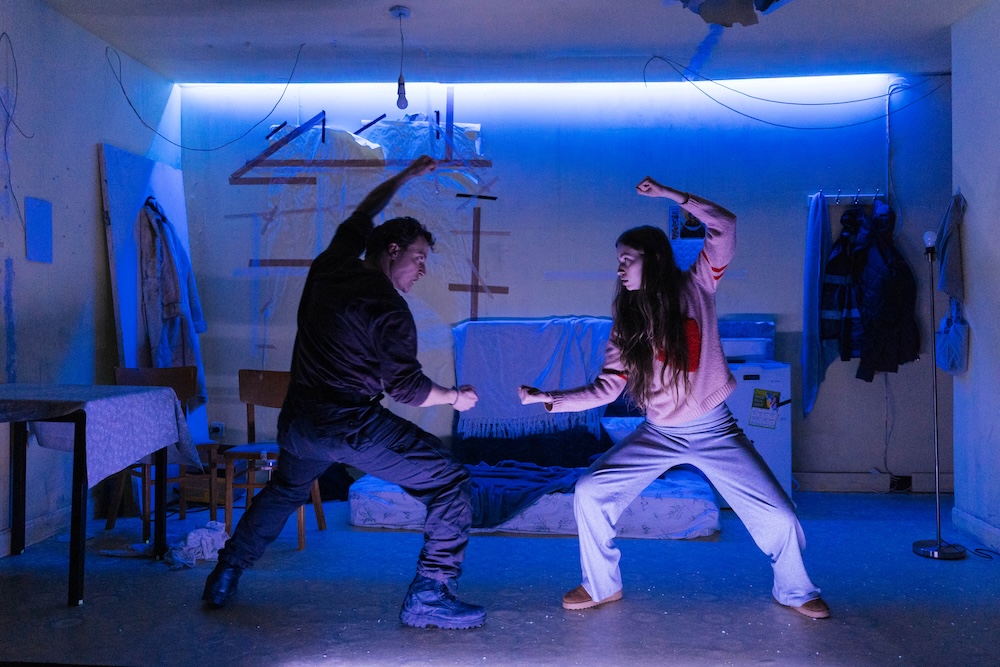
Today, in Geneva, there are tentative peace talks between Ukraine and Russia; today, in London, there is a powerful play about the ongoing war. Oddly enough, it is fringe venues, the Finborough, Camden People’s Theatre and the Arcola, that have led the way in exploring this conflict, while the mainstream flagships have been silent. So much for British theatre’s much lauded reputation for political relevance. Now another underfunded fringe venue, Theatre 503, stages Olga Braga’s Donbas, winner of their International Playwriting Award, in a terrific production by Anthony Simpson-Pike, his first as the new artistic director of this new-writing theatre, in a co-production with Good Chance and 45North.
Set in February 2022, just as the war is about to begin, the story is located somewhere in Donbas, a region which since 2014 has been fought over by Russian-backed separatists and Ukrainian government forces. The main events take place in Seryoga’s house and involve two families. In his 50s, he is a Ukrainian widower who lives with Marianca, a 32-year-old Moldovan woman. At the start of the play, his 20-something son Sashko returns, having just been released from prison for throwing rocks at Russians. Their place is also a home-from-home for 15-year-old Nadya, whose grandmother Vera, living nearby, is waiting for the return of her daughter and who spends time with Ivan, an elderly Russian. Across the way, in an abandoned house, Dmitry, a Russian sniper, and Alexei, of mixed Soviet heritage, watch over the curfew and take pot shots at anyone who breaks it.
All of the characters are aware of passing warplanes, but their main preoccupation is day-to-day survival. Seryoga works at a construction site, and has acquired a Russian passport, essential to help him get insulin for his diabetes, all of which angers Sashko, a passionate nationalist who also blames his father for his mother’s death. When they argue, Seryoga points out that resistance to the Russians in an area which has so many Russian speakers and whose old folk, like Ivan, remember the former Soviet Union as a time of stability, is futile. His son, he says, should get a job and be independent. But Sashko, who has developed a talent for drawing, furiously rejects any activity which collaborates with the enemy. At home all day, he becomes close to both Marianca and Nadya, a needy teen who doesn’t speak.
Watched from afar by Dmitry and Alexei, who bicker and squabble as they wait for the invasion to start, the Seryoga household becomes a place of dreams — and sexual attraction. Central to the psychology of this claustrophobic family is the love triangle of father, mistress and son, here given a lightly Oedipal twist. The tensions between Seryoga, Marianca and Sashko culminate in an excruciating episode when the father deliberately spills his beetroot soup, forcing Marianca to clean it up, while his son tries to stop her. In other scenes, Sashko helps Nadya overcome her mute condition by drawing pictures which tell stories of the Cossack past, when Ukrainians, led by hetman Bohdan Khmelnytsky, fought against Polish-Lithuanian rule. In his dream-mind, Sashko equates this with other struggles against the Tartars, Turks, Swedes — and now the Russians. Fantasies about the heroic past inspire them both to fight the invaders.
Braga not only articulates this nationalistic fervour, but also criticizes it. At one point when Sashko talks about “real 100 per cent Ukrainians”, his father points out that their Grandma Raisa was a “solid Russian”, and that Bohdan led pogroms against the Jews. No one is pure, either in blood or morality. Similarly, Dmitry discovers that Alexei’s mother is Armenian, or something like that, not ethnically Russian, while old Ivan still wears the Order of the Red Star, having been “born into a country that no longer exists”, meaning the Soviet Union. This picture of national and ethnic diversity is an explicit criticism of easy and clichéd notions of identity and belonging. The piece also urgently argues for moral complexity.
Despite this, both Sashko and Nadya are gripped by impassioned nationalism that includes violent fantasies of saturating the land with blood, of resurrecting Cossack uniforms and Cossack swords, of a kind of holy war against invasion from the East. They practice pretend sword fighting. And the poetry of firebirds and cranes as metaphors of freedom, however violent, rings through the play’s ending. But Sashko’s idea of dying “a good death” and Nadya’s feeling that her absent mother is now part of the earth, which remembers her, are ultimately shown as compensation for impotence, rationalisation of trauma. Against these visionary imaginings, Seryoga, for all his faults, comes across as a sympathetic rationalist. And the plot of the play suggests that random acts of violence are the main danger to the characters.
Donbas is written with an excellent mixture of dialogue, meditative speeches and wonderful flights of fantasy. Braga is admirably restrained when suggesting the prevalence of sex work as a way of getting by for women, and also highlights the grim necessities such as the struggle for earning a living in extreme circumstances, when the availability of food can’t be taken for granted. She is also very sympathetic to mothers, like Marianca, whose children are distant and whose family depends on her for money, or Vera, whose daughter is away. Throughout the drama, there is a wonderful dialectic in the writing: Braga shows how resistance is, at one and the same time, both inevitable and doomed; how national pride is both inspiring and corrupting; how history is both mythical and true.
The playwright’s writing is not only exceptionally humanistic, but also beautifully specific: early on, while Ivan gives Vera a L’Oreal hair dye, to make her look like Claudia Schiffer, the others eat Korovka sweet fudge toffees (which I also remember from growing up in West London’s Polish community). Likewise, Nadya’s memories of her absent mother are physical and gendered, the way she combed her hair, her advice about mitigating period pains. On the other hand, it has to be admitted that Donbas, for all the power of its representation of Ukrainian history and the current conflict, is not a perfect work. Running at 100 minutes, it doesn’t explore its love triangle as deeply as it could, and it contains enough material for at least two other plays.
Nevertheless, there’s a lot to love in Simpson-Pike’s production, which gestures towards some spectacular effects as befits this epic vision of a nation on the brink. Niall McKeever’s set conveys the poverty, material as well as spiritual perhaps, of living under the imminent threat of war, while his costumes give the Cossack apparitions a vivid stage presence. Making their stage debuts, Jack Bandeira and Ksenia Devriendt are excellent as the unexpected soul mates Sashko and Nadya, while Philippe Spall’s weary Seryoga and Sasha Syzonenko’s warmhearted Marianca are both convincing. On a lighter note, Steve Watts and Liz Kettle as Ivan and Vera are both charmingly affectionate and finally tragically sad. Bandeira and Spall also double effectively as the Kalashnikov-toting Dmitry and Alexei. Despite its imperfections, Donbas is a superb example of international new writing — the best account of Ukraine currently on the London stage.
This review first appeared on The Theatre Times